Aug
05
2026
 🐬
🐬Shuang Song
Postdoctoral Researcher
Harvard University
About Me
Hi 😊! I am Shuang Song, a postdoctoral researcher mentored by Prof. Xihong Lin in the Department of Biostatistics at Harvard University. I received my Ph.D. under the joint supervision of Prof. Jun S. Liu and Prof. Lin Hou in Tsinghua University. During my Ph.D., I had the privilege of being a visiting researcher at the Big Data Institute at the University of Oxford, where I was mentored by Prof. Augustine Kong.
Before pursuing my Ph.D., I obtained my B.S. in Mathematics from Tsinghua University. I was also a visiting researcher in the Department of Biostatistics at Yale University, mentored by Prof. Hongyu Zhao.
Currently, I'm on the job market. Please don't hesitate to contact me if you are interested in my research or would like to share any ideas 🥳!
Interests
- Statistical Genetics / Genomics
- Bayesian Methodology
- High-dimensional Data Theory
- Whole-genome Sequencing
- AI-empowered Statistical Methods
Experience
Postdoctoral Researcher (2024 - Present)
Harvard University
Ph.D. in Statistics (2019-2024) B.S. in Mathematics (2015-2019)
Tsinghua University
Researcher (2022-2023)
University of Oxford
Researcher (2018)
Yale University
Algorithm Intern (2021)
Kuang-chi Institute of Advanced Technology
📚 My Research
I am broadly interested in developing statistical and machine learning methods to advance precision medicine and improve human health. 🧬My current research focuses on whole-genome sequencing and AI-empowered statistical genetics. I am also interested in the statistical theory of high-dimensional methods and Bayesian methodologies.
Additional areas of interest include polygenic risk prediction, heritability estimation, participation bias, and multi-omics integration. I am passionate about creating scalable, interpretable tools that translate methodological advances into meaningful impact in genetics and genomics.
📖 Featured Publications
📜 Recent Publications
(2026).
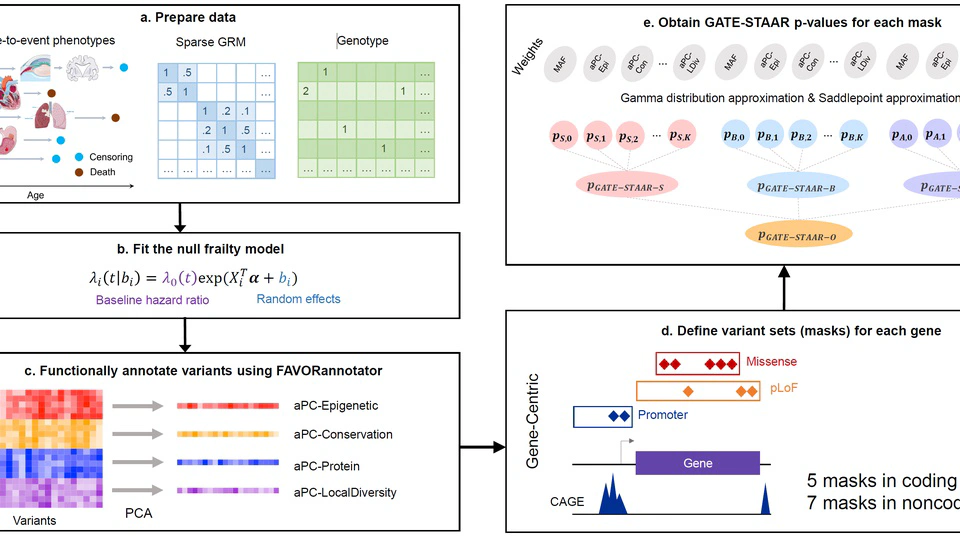
Scalable and accurate rare variant association tests for whole genome sequencing time-to-event analysis in large biobanks.
Proceedings of the National Academy of Sciences (PNAS).
(2025).
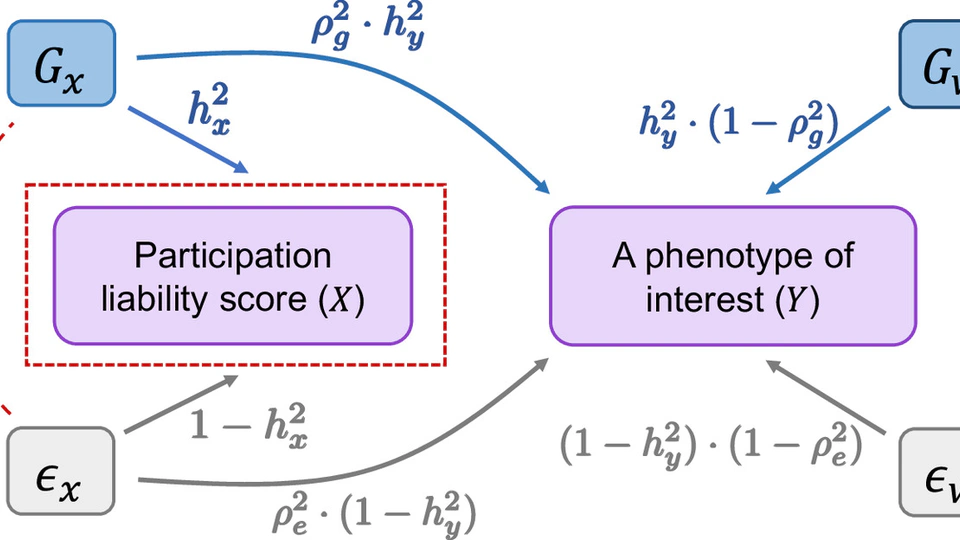
Participation bias in the estimation of heritability and genetic correlation.
Proceedings of the National Academy of Sciences (PNAS).
(2024).
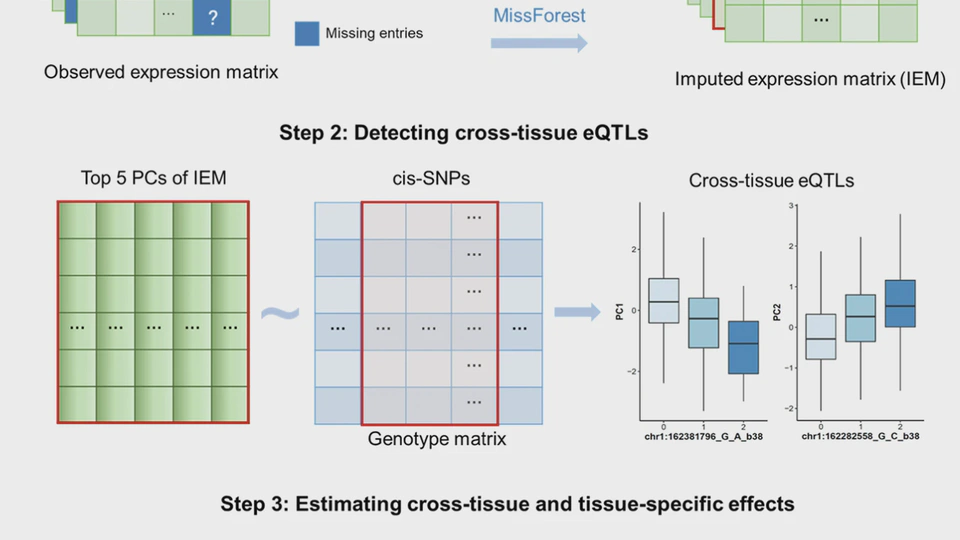
Partitioning and aggregating cross-tissue and tissue-specific genetic effects to identify gene-trait associations.
Nature Communications.
(2022).
Leveraging LD eigenvalue regression to improve the estimation of SNP heritability and confounding inflation.
The American Journal of Human Genetics.
(2022).
A data-adaptive Bayesian regression approach for polygenic risk prediction.
Bioinformatics.
(2021).
Openness weighted association studies: leveraging personal genome information to prioritize non-coding variants.
Bioinformatics.
(2020).
Leveraging effect size distributions to improve polygenic risk scores derived from summary statistics of genome-wide association studies.
PLOS Computational Biology.
(2022).
Multi-Cell-Type Openness-Weighted Association Studies for Trait-Associated Genomic Segments Prioritization.
Genes.
(2021).
A set of efficient methods to generate high-dimensional binary data with specified correlation structures.
The American Statistician.
(2021).
Law of the Iterated Logarithm and Model Selection Consistency for Independent and Dependent GLMs.
Frontiers of Mathematics in China.
(2025).
The predictive value of the orientation and offset of angle α and angle κ for visual outcomes after trifocal intraocular lens implantation in an Asian cohort.
Graefe’s Archive for Clinical and Experimental Ophthalmology.
(2025).
The Effects of Disease‐Modifying Therapies on Optic Nerve Degeneration in Multiple Sclerosis.
European Journal of Neurology.
(2023).
A robust penalized-regression-based method for multivariable Mendelian randomization using GWAS summary statistics.
Researchsquare.
(2024).
Cofea: correlation-based feature selection for single-cell chromatin accessibility data.
Briefings in Bioinformatics.
(2022).
Cell type annotation of single-cell chromatin accessibility data via supervised Bayesian embedding.
Nature Machine Intelligence.
(2021).
A novel transcriptional risk score for risk prediction of complex human diseases.
Genetic Epidemiology.
(2022).
An unbiased kinship estimation method for genetic data analysis.
BMC Bioinformatics.
(2021).
Correcting statistical bias in correlation-based kinship estimators.
bioRxiv.
(2024).
Blood Glucose Levels Moderate the Associations Between IGF-1 Levels and Choroidal Metrics in Patients With Diabetes With Acromegaly Without Diabetic Retinopathy.
Translational Vision Science & Technology.
(2021).
Reduction of Human Mobility Matters during Early COVID-19 Outbreaks: Evidence from India, Japan and China.
International Journal of Environmental Research and Public Health.
🏆 Awards
- PQG Travel Award (2026)
- NSF Travel Award for the ICSA Applied Statistics Symposium (2025)
- “Zhong Jiaqing” Award in Probability and Statistics (2023)
- Outstanding Doctoral Dissertation (2024)
- Outstanding Graduate of Beijing (2024)
- Outstanding Graduate of Tsinghua University (2024)
- President Scholarship (Only awarded to 20 students) (2021)
- First Prize “RONG” Scholarship (2021)
- “BeiGene” Paper Award for Youth Scholars, Outstanding paper (2020 & 2021)
📅 Recent & Upcoming Talks
🔑 Software
🧪 Heritability / Genetic Correlation
Methods for SNP heritability and participation-bias correction.
📈 Polygenic Risk Prediction
Polygenic risk score modeling and Bayesian prediction tools.
🧰 Statistical Tools
Generate high-dimensional binary data with specified correlation structures.
👩💻 Service
Reviewer:
- Nature Communications
- The American Journal of Human Genetics
- npj Digital Medicine
- IEEE/ACM Transactions on Computational Biology and Bioinformatics
- BMC Bioinformatics
- BMC Medicine
- Scientific Reports
- Orphanet Journal of Rare Diseases
Teaching:
- Teaching Assistant for Probability Theory (2021)
- Teaching Assistant for the Science and Art of Data Analysis (2021)
- Teaching Assistant for Mathematics History (2020 & 2021)
📰 Recent News